
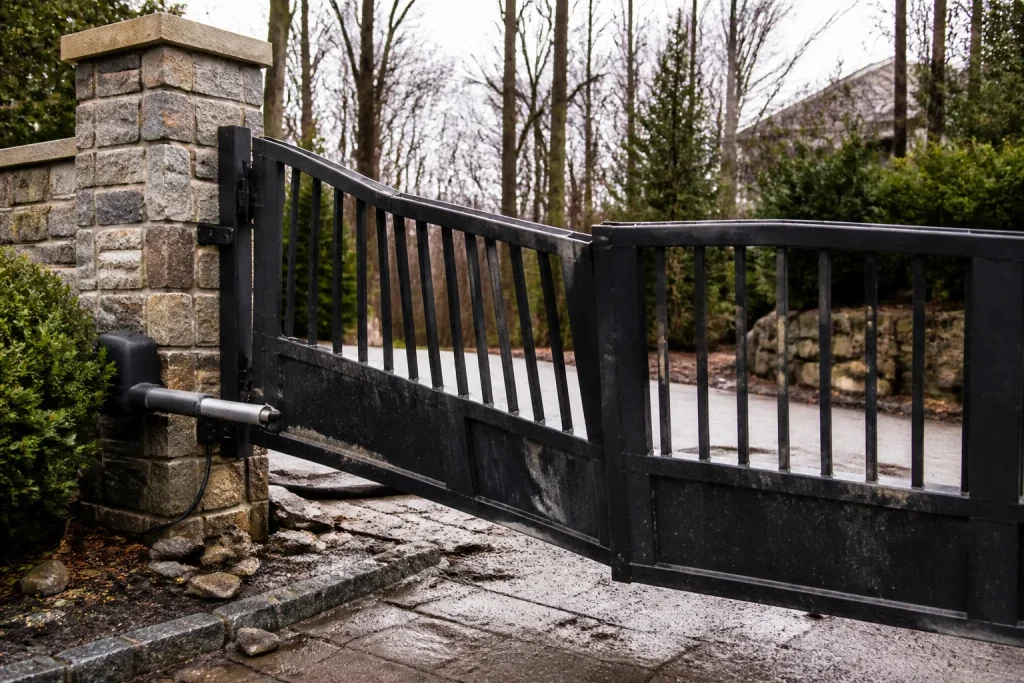
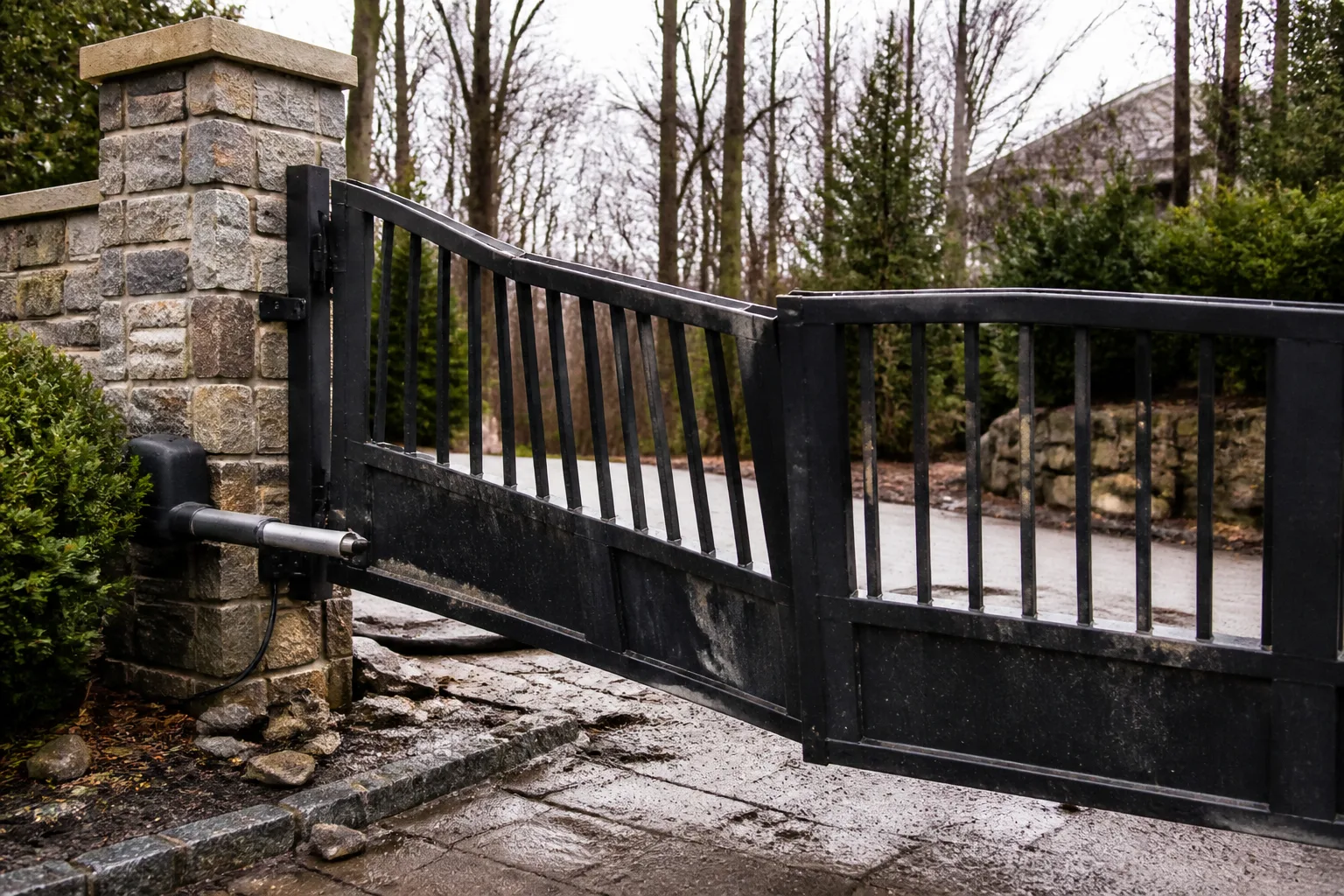
Emergency Gate Repair Near Me: What Buffalo Homeowners Should Do First
When a gate fails, the first five minutes of decisions either contain the damage or make it worse. The manual release handle on your operator is the most important piece of hardware on the system, and the worst time to discover you don’t know where it is or how it works is 11 PM in a Buffalo January with the gate stuck across your driveway. We’re a gate-only company, so we’ve walked Buffalo homeowners through this exact moment more times than we can count. Here’s the sequence to follow, in order. If you’d rather not troubleshoot in the cold, call (877) 283-9515 and we’ll talk you through it.
Key Takeaways
- Before anything else, find your operator’s manual release and confirm which type it is, because releasing a swing gate operator the wrong way can drop the gate.
- Stuck open means a security problem; stuck closed usually means a convenience problem. Know which one you’re facing before you call.
- Have the operator make and model, a photo of the arm or track, and a note on the last normal behavior ready before you dial.
- The lowest after-hours quote is often the most expensive outcome. Ask who is answering and whether gates are all they work on.
What Should You Do First When Your Gate Fails in Buffalo?
Stop and identify whether the gate is stuck open or stuck closed before you touch anything. That single fact decides your next move. A gate stuck closed blocks a vehicle but keeps the property sealed. A gate stuck open leaves the driveway, yard, or commercial lot exposed, and that changes from an inconvenience into a security problem the moment it happens. In Buffalo, a gate left open overnight in a snowbelt neighborhood is far more urgent than one that simply won’t slide.
From there, work this short sequence:
- Listen to the operator. A hum with no movement usually points to a mechanical bind, a stripped gear, or a slipping chain. Total silence points to power, a tripped breaker, or a dead control board. A repeated click without motion is often a safety sensor or a limit switch issue.
- Check the obvious before the technical. Confirm the breaker hasn’t tripped, the disconnect switch inside the operator housing is on, and nothing is blocking the safety sensors on an automatic gate.
- Do not force the gate. Pushing, prying, or dragging a stuck gate by hand can bend the arm, strip the operator, or send a heavy panel off its track.
- Find your manual release and read the next section before you pull it.
Once you know the symptom and which kind of operator you have, you can decide whether to release the gate or leave it for a technician.
How Do You Release an Automatic Gate Manually Without Damaging It?
You release a gate by finding the manual release on the operator, following that operator’s specific procedure, and never releasing a swing gate while its arm is under load. This is where most damage happens. The three operator families we see most on Buffalo residential properties each release differently, and two of them punish a wrong move.
Swing gate arm operators
Most residential swing gates use an articulated arm operator. These typically release with a key, a lever, or a hex key on the arm itself, which disengages the gear and lets the arm float. The warning here matters: if you release the arm while the gate is on a slope or under pressure, the gate can swing freely and hard. Support the gate before you touch the release.
Sliding gate operators
Sliding operators usually release with a manual clutch lever, a key-release, or a chain hoist depending on the model. Once released, the gate rolls along its track by hand. Check that the track is clear of ice and debris first, because a gate that was stuck on a frozen track will suddenly move once released and can pick up speed.
Lift-style and barrier operators
Some Buffalo properties use lift-style arms or barrier gates, common on commercial driveways and parking lots. These release with a lever or crank and should be lowered slowly, never dropped.
Every make behaves a little differently, which is why brand familiarity matters. We work on Ghost Controls, Mighty Mule, DoorKing, Elite, and the rest of the nine major brands, and recognizing the release mechanism on sight saves a lot of guesswork. If you’re not sure which operator you have, take a photo of the housing label and call (877) 283-9515.
How Do You Secure a Gate That’s Stuck Open?
The fastest way to secure a stuck-open gate is to close it manually if the release allows, then pin or brace it in the closed position without damaging the operator. If the gate won’t close, your next option is a temporary barrier: a vehicle parked across the opening, a chain or cable rated for the span, or a portable barricade for a commercial lot. These restore basic security while you wait for a technician.
A few ground rules keep the temporary fix temporary:
- Never wedge anything into the operator or the drive mechanism. Shoving a block of wood or a bar into a sliding gate’s track to hold it is tempting and it’s how gearboxes and arms get ruined.
- Brace at the gate frame, not the motor. A strap, cable, or chain across the gate leaves and the post is the safe place to secure it.
- Keep the safety edges working. If your automatic gate has safety sensors or reversing edges, don’t disable them to force the gate shut. A gate that reverses on contact is the one piece of the system you want alive.
- Flag the hazard. A gate stuck partway across a driveway at night is a trip hazard and a vehicle hazard. Something visible helps.
For a commercial property manager in Buffalo, a gate stuck open on an access-control driveway is a security event, not a maintenance note. Get it braced, log it, and get a technician scheduled the same day if you can.
What Information Should You Have Ready Before You Call?
Have three things ready before you call for emergency gate repair: the operator make and model, a couple of clear photos, and a plain description of the last normal behavior. That single package lets a technician arrive with the right parts and diagnose in minutes instead of an hour. In our experience, gate failures are usually brand- and model-specific, and the difference between “the gate is broken” and “the Mighty Mule operator hums and the arm doesn’t move” is the difference between a same-visit fix and a second trip.
Worth gathering:
- The operator label. A photo of the model plate on the housing or control box.
- Photos of the gate and the fault. The arm or track, the gate position, and any error lights on the control board.
- The last normal behavior. Did it slow down, reverse randomly, stop at the same spot, or quit mid-travel? When did it last work?
- Gate type and material. Swing or slide, wood, steel, aluminum, or ornamental iron, and roughly how heavy the panel is.
- Access details. Where the gate is, how to reach the operator, and whether there’s a power disconnect nearby.
Send those before you call (877) 283-9515 and a gate specialist can often tell you what’s wrong before they’re on the property.
Is It Really an Emergency, or a Next-Day Repair?
Most stuck gates are a next-day repair. A gate stuck closed on a residential driveway is usually safe to leave until a scheduled visit, especially if you have another way in and out. A gate stuck open on a property that faces a street, a commercial lot with vehicles already inside, or a gate whose panel is damaged and could fall is a genuine emergency. The line is simple: no exposure and no falling hazard means you can usually wait; exposure or a fall risk means call now.
Here’s how we draw it:
- Wait is usually fine: a gate stuck closed with another access point, a gate that runs but reverses on the safety edge, a noisy operator, a keypad or remote that stopped working while manual operation is fine.
- Call same day: a gate stuck open at a street-facing property, a commercial gate left open with vehicles or inventory inside, a panel that’s off its track, an operator making a grinding sound and smoking, or a gate that’s been forced and won’t move at all.
- Call immediately: any sign of electrical burning or a burning smell at the operator, a damaged panel leaning under its own weight, or a gate that has dropped onto a vehicle.
When in doubt, ask. We’d rather help you decide than have you guess at 11 PM. Call (877) 283-9515 and describe it.
What Are Red Flags in an Emergency Gate Repair Company?
The biggest red flag in emergency gate repair is a company that can’t tell you who’s answering the phone and what gate brands they actually work on. If the person on the line can’t identify a DoorKing or a Ghost Controls operator by name, or if every answer sounds like a script, you’re probably talking to a call center that will dispatch a generalist. Gates are their own trade, and a handyman who “does gates too” is going to spend an hour with a meter learning your system.
Watch for these:
- A vague quote with no written estimate. The price should be agreed before any work starts, not dictated after.
- The lowest after-hours quote. An unbelievably low number usually precedes an unbudgeted “found problem,” a pressure sale on a replacement operator, or a repair that comes back a week later. The cheapest call is often the most expensive outcome.
- Pressure to replace rather than repair. A specialist should try to repair a working system. No brand lock-in means no reason to push a new unit just because yours isn’t on their list.
- No proof of licensing or insurance. Gate work involves electricity, heavy panels, and moving parts. Licensed and insured is the baseline, not a selling point.
- Fear-selling. A “your gate is a security emergency, sign here tonight” pitch is a red flag. A good technician tells you plainly what’s wrong and what it costs to fix.
If you’re in Buffalo and the gate is failing, one call to (877) 283-9515 gets a gate specialist on the line who works on your brand, not a generalist guessing.
When to Call a Pro
Call a pro when the fault is inside the operator, the control board, or the safety system, or when any panel or track has taken damage. Those are the jobs that ruin a system with good intentions. Electric gate work involves live wiring, and heavy panels under load can crush hands and feet, so we don’t put a “how to fix it yourself” sequence in front of anyone. If you’re standing next to a gate that smells like burning, that has a panel leaning, or that’s showing any electrical fault, step back, unplug nothing yourself, and call. From a stuck arm to a dead control board, we’d rather diagnose it than have you chase it.
Related services in Buffalo: gate repair, electric gate repair, and new gate installation across Buffalo.
The Bottom Line
Emergency gate repair starts with a decision, not a phone call. Know whether your gate is stuck open or closed, know your operator’s manual release and whether it’s safe to use, and have your model and photos ready before you dial. Then let a gate specialist handle the diagnosis and the repair. Our technicians have up to 15 years of experience, and we work on nine major brands including Ghost Controls, DoorKing, Elite, and Mighty Mule, so we diagnose by brand-specific knowledge rather than trial and error.
If you’re in Buffalo and need help, Buffalo Gate Repair offers free estimates. Call (877) 283-9515. We answer 24/7. Fast dispatch, 7am-7pm, Sunday through Friday. The price is always set per job by the written estimate, agreed before any work starts.
And when the gate finally runs and the driveway is secure, you can put the snow shovel down and get back inside. You’ve earned it.
Frequently Asked Questions
Yes, usually, if you use the operator’s own manual release and understand its warning. Swing arm operators disengage with a key or lever at the arm and the gate can swing freely if it’s under load, so support it first. Sliding operators release with a clutch or key-release and roll by hand once the track is clear. If you’re unsure of the type, don’t force it. Call (877) 283-9515 and we’ll help you identify it.
We don’t quote a number over the phone because gate failures vary too much, but the estimate is free and the final price is set per job by the written estimate, agreed before work starts. You’ll know exactly what the repair costs before we begin. Call (877) 283-9515 for an exact quote.
We answer 24/7. Fast dispatch, 7am-7pm, Sunday through Friday. A call outside dispatch hours is booked into the next opening. Call (877) 283-9515 as soon as the gate fails.
Usually not. A stuck-closed gate blocks access but leaves the property sealed, so it’s often fine to schedule for the next opening. It’s an emergency when the gate is stuck open and leaves your property exposed, a panel has dropped, or you see or smell burning at the operator. Call (877) 283-9515 and we’ll help you judge it.
Written by the team at Buffalo Gate Repair.
Need Gate Repair Help?
Call Buffalo Gate Repair - licensed & insured, here with fast help in Buffalo.
(877) 283-9515