
Ghost Controls Gate Repair in Buffalo: A Homeowner’s Guide
Most Ghost Controls failures we see in Buffalo aren’t motor failures at all. They’re power failures. The operator is sold as a solar-friendly, DIY-installable system, and for a lot of driveways it genuinely is. Then February arrives, the panel sits under a gray sky for a week, and the gate stops mid-travel. The owner assumes the operator is dead and starts shopping for a replacement. Usually the operator is fine. If you’d rather not climb this particular ladder, call (877) 283-9515.
This guide is for the homeowner who installed a Ghost Controls system, liked it, and now wants to understand what actually went wrong. We work on these units regularly, alongside systems from FAAC, Linear, Viking and others, and the failure patterns are consistent enough to walk through in plain terms.
Why Does My Ghost Controls Gate Keep Losing Charge in Buffalo?
Because Buffalo’s solar conditions in winter rarely meet what the charge controller expects. Snow cover, short daylight hours and long stretches of overcast sky push a solar-charged operator below its usable threshold, and the unit shuts down to protect the battery rather than run it flat. The gate isn’t broken. It’s rationing.
The trap is that two very different problems look identical from the driveway:
- Panel output failure. The panel is dirty, shaded by a bare branch, angled wrong after a season of wind, or simply not getting enough light. The battery is healthy but never refilled.
- Battery failure. The battery has reached the end of its service life and no longer holds a charge even when the panel delivers current.
Before replacing anything, measure. A technician checks panel voltage in open light, then battery voltage under load, then compares the two against the controller’s cutoff behavior. Replacing the battery when the panel is the problem wastes money and the new battery fails the same way. Replacing the panel when the battery is tired does the same. We’ve watched homeowners do both in the same season.
One practical note for Buffalo winters: clear snow off the panel after a storm. It sounds obvious. It’s also the cheapest repair on this entire page.
What Do Ghost Controls Error Codes Tell You About Actuator Rod Binding?
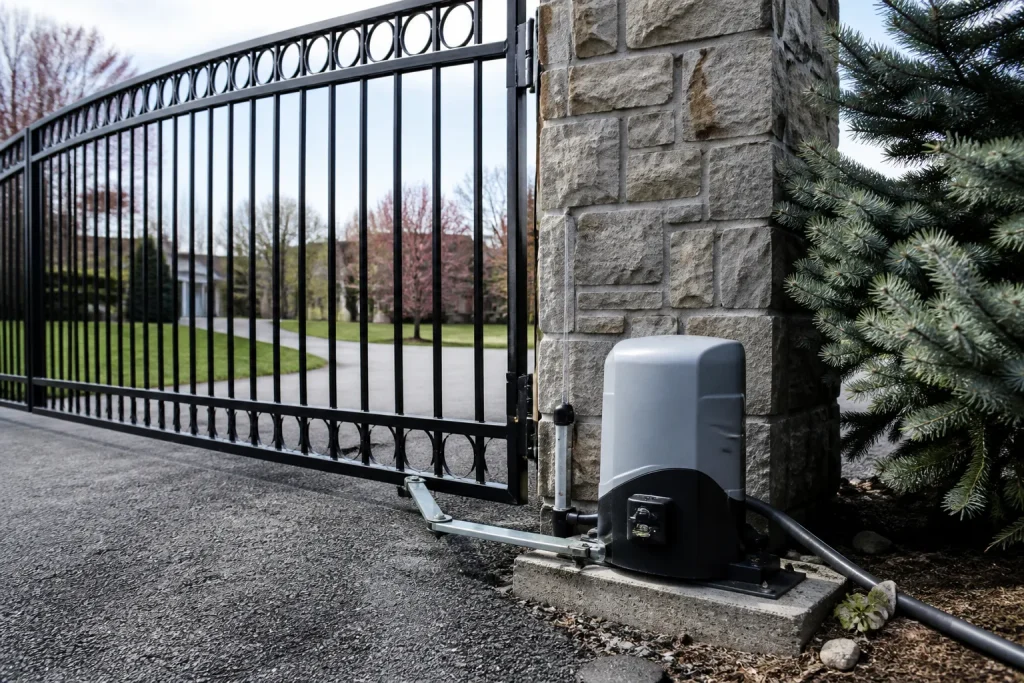
Repeated fault codes paired with a gate that sounds strained or stalls before completing travel usually point to actuator rod binding, not an electronics fault. The arm is fighting resistance it shouldn’t have, and the controller reports that fight as an error.
Buffalo makes this worse than most places. Road salt and winter grit get onto the exposed actuator rod threads, dry them out, and turn a smooth surface into a gritty one. Add a season of freeze-thaw and the rod stops moving freely. The operator gets blamed. The rod is the actual culprit.
What to check, without disassembling anything:
- Whether the gate moves freely by hand with the operator disengaged. If it drags, the problem is the gate, not the motor.
- Whether the actuator rod shows rust, pitting or dried grease on the threads.
- Whether the fault repeats at the same point in travel every time, which points to binding rather than a random electrical glitch.
- Whether the gate hinges have stiffened over the winter, adding load the operator was never sized for.
Cleaning and re-greasing the rod, correcting the arm geometry and freeing the hinges often resolves it. What we don’t recommend is increasing force settings to push through the binding. That masks the problem and shortens the life of the operator.
Why Does One Gate Leaf Reverse While the Other Keeps Moving?
A dual-gate Ghost Controls system uses a synchronized pairing between the two operators, and the most common cause of one leaf reversing while the other continues is a lost or mismatched sync configuration after a battery disconnect, a power interruption or a control board replacement. One operator still holds the original pairing data. The other doesn’t.
This shows up most often in spring, right after a winter that drained the batteries or prompted someone to swap a board. The gates were fine in the fall. Now one leaf travels, hits its limit, and reverses while its partner carries on as if nothing happened.
What tends to be involved:
- Misconfigured master/slave roles. Both operators need to agree on which one leads.
- Staggered travel timing. The delay between leaves needs to match the gate, not a default.
- Limit positions that don’t match the physical stops after the gate has shifted on its hinges over a season.
This is one of the few Ghost Controls problems a support forum genuinely can’t solve remotely, because the fix depends on how your specific gate is hung and where its stops actually sit. It’s a fifteen-minute job on site and a frustrating afternoon on your own. If you’d rather skip the afternoon, that’s what we’re here for.
What Does the Ghost Controls Warranty Cover, and What Voids It?
Ghost Controls publishes its own warranty terms, and they’re specific to the product line, so read the document that came with your unit rather than a summary. That said, the pattern across gate operators is consistent, and it’s worth understanding before you pick up a screwdriver.
Generally covered: manufacturing defects in the operator, control board and major components within the stated period.
Generally not covered, or at risk of being excluded:
- Batteries, which are consumable and typically carry a much shorter term than the operator itself.
- Damage from water intrusion, insect nesting, power surges or incorrect wiring.
- Failures traced to installation errors, wrong arm geometry or an operator sized for the wrong gate.
- Damage caused by attempting a repair yourself in a way the manufacturer considers improper.
That last point is the one that matters here. Opening a sealed control enclosure or swapping a board without following the manufacturer’s procedure can turn a covered failure into an out-of-pocket one. If your unit is still inside its warranty window, have a technician confirm the fault first. A board swap is straightforward when it’s done correctly and expensive when it becomes a warranty dispute.
Repair the Part or Replace the Operator: Which Makes Sense?
Component-level repair is usually the right call when the operator housing and motor are sound and the failure sits in one identifiable part. Full replacement makes sense when the housing has corroded through, the motor has failed, or the unit is old enough that the next failure is already queued up behind this one.
What a specialist can typically repair without replacing the whole system:
- Actuator rebuild. New rod, seals and grease where the housing is still solid.
- Control board replacement. The most common electronics fix, and often the fastest.
- Battery and charging system work. Battery, panel, controller, wiring.
- Limit and sync reconfiguration. No parts at all, just correct setup.
- Safety sensor and accessory faults. Photocells, keypads, remotes and loop wiring.
When it tips toward replacement: a cracked or water-filled housing, a motor that overheats under normal load, or a unit where two or three major parts are marginal at once. At that point the math favors a new operator. It’s also worth knowing that brand-agnostic repair works in your favor here. We service systems from FAAC, Linear and BFT just as readily as Ghost Controls, so nobody’s steering you toward a specific brand because it’s the only one they know.
When to Call a Pro
Gate operators sit on a live power circuit and drive a heavy moving panel. Battery and panel checks are reasonable for a homeowner. Opening the control enclosure, rewiring the operator, and adjusting force or limit settings are not, particularly on a gate that can crush. If your unit is under warranty, call before you open anything. Our technicians have up to 15 years of experience, and diagnosing both a mechanical and an electronic fault in one visit is routine for us.
Related services in Buffalo: for mechanical failures, see gate repair; for motor, board and sensor faults, see electric gate repair.
For context on the wider range of work we handle around Buffalo, including installation, our main page covers the full picture.
The Bottom Line
Most Ghost Controls calls in Buffalo trace back to four things: solar charging that can’t keep up with a lake-effect winter, actuator rods binding on road salt, a dual-gate sync that lost its pairing, and a battery that’s simply done. Diagnose before you replace. The panel, the battery and the rod get blamed for each other constantly, and guessing gets expensive fast.
If you’re in Buffalo and need help, Buffalo Gate Repair offers free estimates. We answer 24/7, with fast dispatch from 7am to 7pm, Sunday through Friday. The price is quoted and agreed before any work starts, so there’s no surprise on the invoice. Call (877) 283-9515. For a broader look at what we do, see Buffalo Gate Repair.
Frequently Asked Questions
It can almost always be repaired. Actuator rebuilds, control board swaps, battery and charging work and limit reconfiguration are all standard repairs. Replacement only makes sense when the housing is compromised or several major components are failing together.
Measure both. A technician checks panel voltage in open light and battery voltage under load, then compares them against the controller’s cutoff behavior. If the battery holds charge when the panel delivers current, the panel or its wiring is the fault. If it drops under load, the battery is the fault.
It can, if the work isn’t done to the manufacturer’s procedure, particularly inside the control enclosure. If the unit is still inside its warranty window, have the fault confirmed first so a covered failure stays covered. Read the warranty document that came with your unit for the exact terms.
Yes. We work on Ghost Controls, FAAC, BFT, Linear, Viking, LiftMaster, DoorKing, Elite and Mighty Mule. Diagnostics are brand-specific, so you get a technician who knows the system you already own rather than one learning it on your driveway. Call (877) 283-9515 for a free estimate.
Written by the team at Buffalo Gate Repair.
Need Gate Repair Help?
Call Buffalo Gate Repair - licensed & insured, here with fast help in Buffalo.
(877) 283-9515